Mines vs Plinko on Mostbet -- Which Game Has Better Odds?

Both Mines and Plinko are Spribe games available on Mostbet. Both are provably fair. Both have similar RTPs. But they're fundamentally different experiences. I've played 200+ rounds of each and here's how they compare on everything that actually matters.
Quick Comparison Table
| Feature | Mines | Plinko |
|---|---|---|
| Developer | Spribe | Spribe |
| Game Type | Grid-based, click to reveal | Ball drop, gravity physics |
| RTP | ~96-97% | ~97% |
| House Edge | 3-4% | ~3% |
| Player Control | High (mine count + cashout timing) | Low (risk level + row count) |
| Decisions Per Round | Multiple (click or cash out at each gem) | One (drop the ball) |
| Variance Control | 1-24 mines (massive range) | Low/Medium/High risk mode |
| Provably Fair | Yes | Yes |
| Max Multiplier | Depends on mine count (up to thousands x) | Up to 1,000x on high risk |
| Speed | Variable (you control pace) | Fast (ball drops in seconds) |
| Skill Element | Cashout timing discipline | None |
How the Games Work -- Side by Side
Mines
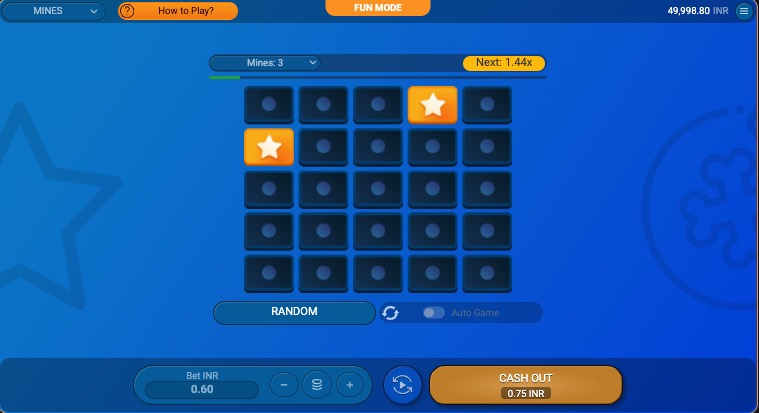
You face a 5x5 grid with 1-24 hidden mines. Click tiles to reveal gems. Each gem increases your multiplier. Hit a mine and lose your bet. Cash out anytime after the first gem. The critical skill is knowing when to stop clicking. Full Mines mechanics here.
Plinko
You drop a ball from the top of a pyramid of pins. The ball bounces left or right at each pin, landing in a slot at the bottom. Each slot has a multiplier. You choose the risk level (Low, Medium, High) and number of rows (8-16). Then you drop the ball and watch. There are no decisions to make after the drop.
Player Control: Where Mines Wins
This is the biggest difference. In Mines, you make a decision at every stage:
- How many mines to set (determines your entire risk profile)
- Which tile to click (mathematically irrelevant but psychologically important)
- After each gem: click another tile or cash out
In Plinko, you make one decision: risk level and row count. Then you drop the ball and physics (RNG) takes over. Zero decisions during the round. Zero control over the outcome once the ball is released.
If you value decision-making and strategic control, Mines is clearly superior. If you prefer a passive "watch and hope" experience, Plinko is simpler.
Variance Comparison
Both games offer variable risk, but the range is different:
| Risk Level | Mines | Plinko |
|---|---|---|
| Very Low | 1 mine, cash out after 1-3 gems. Tiny multipliers, very high win rate. | Low risk, 8 rows. Most drops return 0.5-1.5x. |
| Low | 3 mines, cash out after 3 gems (~1.42x, 67% win rate) | Low risk, 12 rows. Wider spread but still conservative. |
| Medium | 5 mines, cash out after 3 gems (~1.94x, 50% win rate) | Medium risk, 12 rows. More extreme edge slots. |
| High | 10 mines, cash out after 2 gems (~2.76x, 35% win rate) | High risk, 16 rows. Edge slots hit 100x+. |
| Extreme | 24 mines, 1 click (~24x, 4% win rate) | High risk, 16 rows, edge slot: up to 1,000x (~0.1%) |
Mines gives you finer control. The 1-24 mine slider is essentially a continuous risk dial. Plinko gives you three preset risk modes. For a probability nerd like me, Mines' granularity is far more interesting.
RTP Comparison
Both games have similar RTPs:
- Mines: ~96-97% (varies slightly by mine count, consistent ~3-4% house edge)
- Plinko: ~97% (consistent across risk levels)
Plinko has a slightly better RTP on paper. The difference is about 0.5-1 percentage point. Over 1,000 rounds at $1, that's roughly $5-10 difference in expected loss. Not nothing, but not game-changing either.
The more important factor is how the house edge feels in practice. In Mines, you feel the edge through individual mine hits -- visible, sudden losses. In Plinko, the edge is distributed across many slightly-below-fair multiplier slots. Plinko's losses feel more gradual. Mines' losses feel more binary.
Session Experience
Playing 50 rounds of each back-to-back gave me a clear sense of the different experiences:
Mines Session (3 mines, $2 bet)
Slow, deliberate. Each click builds tension. I cashed out after 3-4 gems most rounds. A few mine hits felt sharp -- losing the round instantly. Total time: 35 minutes for 50 rounds. I was engaged the entire time, making decisions every few seconds.
Plinko Session (Medium risk, 12 rows, $2 bet)
Fast, passive. Drop ball, watch it bounce, see result. Next. Total time: 12 minutes for 50 rounds. Moments of excitement when the ball headed toward edge slots. But mostly a repetitive watching experience. Less engaging, but less mentally taxing.
Which Game Should You Play?
Choose Mines if:
- You enjoy making decisions during gameplay
- You want fine control over your risk level
- You prefer slower, more deliberate sessions
- You like probability math and calculating odds
- You want to practice cashout discipline
Choose Plinko if:
- You prefer passive, watch-and-hope gameplay
- You want faster rounds with less thinking
- You enjoy the visual spectacle of the ball bouncing
- You're prone to bad cashout decisions (Plinko removes that temptation)
- You want a marginally better RTP
My Personal Preference
I prefer Mines. The decision-making is the whole game for me. Every gem revealed presents a genuine choice: take the money or press your luck. That tension is what makes gambling interesting (and dangerous -- see our responsible gambling page).
Plinko is fine when I want something mindless. Drop balls, watch physics, check results. But I get bored after 20 minutes because there's nothing to think about. With Mines, I can analyze my cashout patterns, test different mine counts, and actually feel like my decisions matter (even though the house edge means the math always wins long-term).
Both games are well-designed, provably fair, and available on Mostbet. You're not making a bad choice either way. Just choose the experience that matches your preference.
Try both and decide for yourself
Play on Mostbet →Both games available in demo mode -- no real money required.